Also see Rick Delawder
Understanding the Black Oxide Process: Benefits and Applications
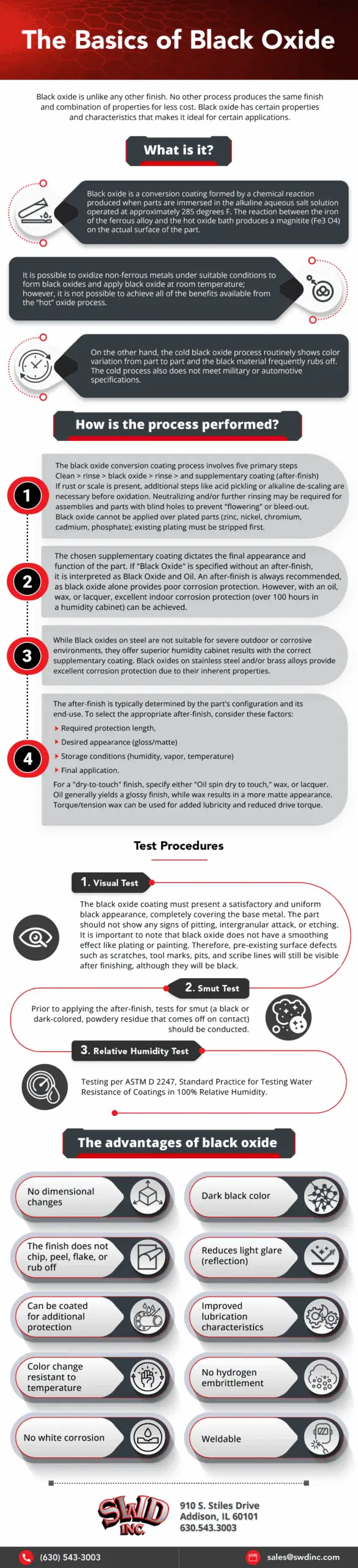
Black oxide is unlike any other finish. No other process produces the same finish and combination of properties for less cost. Black oxide has certain properties and characteristics that makes it ideal for certain applications.
What is it?
Black oxide is a conversion coating formed by a chemical reaction produced when parts are immersed in the alkaline aqueous salt solution operated at approximately 285 degrees F. The reaction between the iron of the ferrous alloy and the hot oxide bath produces a magnitite (Fe3 O4) on the actual surface of the part. It is possible to oxidize non-ferrous metals under suitable conditions to form black oxides. It is possible to apply black oxide at room temperature, however it is not possible to achieve all of the benefits available from the “hot” oxide process. The cold black oxide process routinely shows color variation from part to part and the black material frequently rubs off in your hands. The cold process does not meet military or automotive specifications. Therefore the remainder of this article addresses the “hot” black oxide process.How is the process performed?
The five basic steps for the black oxide conversion coating are clean; rinse; black oxide; rinse; supplementary coating (after-finish). If rust or scale is present on the part, additional steps such as acid pickling or alkaline de-scaling may have to be added before oxiding. Neutralizing and/or further rinsing may be necessary on assemblies and parts with blind holes to eliminate “flowering” or bleed-out. Black oxide cannot be produced over plated parts (zinc, nickel, chromium, cadmium, phosphate). This plating must be stripped prior to the black oxide process. The supplementary coating (after-finish) will dictate the final appearance and function of the part. When a print or drawing specifies “Black Oxide” without any specific after-finish, it is interpreted as Black Oxide and Oil. It is recommended that an after-finish is always applied, as black oxide without an after-finish has very poor corrosion protection. However, with an oil, wax, or lacquer, it is possible to achieve excellent indoor corrosion protection (100+ hrs. in a humidity cabinet). Black oxides on steel are not suitable for severe outdoor applications or corrosive environments, but they can provide superior humidity cabinet results with proper supplementary coating. Black Oxides on Stainless steel and/or brass alloys will yield excellent corrosion protection, primarily due to their inherent properties. The after-finish is usually determined by the part configuration and the end-use. If a “dry-to-touch” finish is needed, it is important to specify either Oil spin dry to touch, wax or lacquer. The oil after-finish will generally be a glossy finish, whereas the wax will be more matte. It is possible to use a torque/tension wax to provide added lubricity and reduced drive torque. In order to determine the appropriate after-finish, you must first evaluate which after-finish to use. The following factors should be considered:- Length of protection required
- Desired finished appearance (gloss/matte)
- Storage conditions (humidity, vapor, temperature)
- Final application
Test Procedures
Visual Test – The black oxide coating shall exhibit a satisfactory appearance. The black oxide coating shall cover the basis metal completely and shall be a uniform shade of black. The part shall show no evidence of pitting, intergranular attack, or etching. Please note: Black oxide does not exhibit a smoothing effect like plating or painting. Pre-existing scratches, tool marks, pits, scribe lines, and other surface defects will be visible after finishing (although they will be black). Smut Test – Smut is a black or dark-colored, powdery residue, which comes off on the hand when rubbed. such tests shall be performed prior to the application of the after-finish. Relative Humidity Test – Testing per ASTM D 2247, Standard Practice for Testing Water Resistance of Coatings in 100% Relative Humidity. The advantages of black oxide are:-
- No dimensional changes:The as-formed dimensions do not change (as they do when plated or painted). Black oxide is a coloring of the base metal, no metal is removed or deposited.
- Dark black color:(No patina or rainbow effect) The surface of the part may be shiny or matte depending on the surface of the part and the after finish applied. For example, a polished surface will retain its luster after black oxidizing.
- The finish will not chip, peel, flake, or rub off:Black oxide can only be removed by mechanically or chemically removing the finish itself.
- Reduces light glare (reflection):Black oxide makes an excellent finished surface for moving parts such as hand tools and machine parts. The reduction in reflectivity reduces eye fatigue and is less distracting.
- Can be coated for additional protection:Black oxide finishes with supplementary treatments (“after-finishes”) improve the appearance, abrasion resistance, and corrosion resistance of the part to which they are applied. The normal after-finishes are Oil, Wax, Lacquer, and Chromic Seals. The part configuration and the end-use will help to determine which after-finish to specify.
- Improved lubrication characteristics:Black oxidized parts have improved lubricity and anti-galling characteristics due to the after-finish (oil or wax) resulting in smoother running, mating parts.
- Color change resistant to temperature:Black oxide finishes can be exposed to a temperature of 900 degrees F. (482 degrees C.) before the color begins to change.
- No hydrogen embrittlement:The black oxide process does not require an acid activation nor is it an electro-process; therefore, hydrogen embrittlement is not a factor. If the parts are scaled or rusty and an acid pickle is required, any hydrogen that may have evolved will quickly dissipate in the black oxide tank (running temp. 285 degrees F). Any remaining hydrogen will be completely dissipated within 48 hours after processing.
- No white corrosion:The finished part does not have a “white-corrosion” state as some electro-plated parts exhibit over time. This makes black oxide an excellent finish for parts used internally on electronic components. The small white corrosive flecks are conductive and may cause an electrical short.
- Weldable:Welding black oxided parts does not produce noxious fumes nor hamper the ease with which a part can be welded as may be encountered by welding plated or painted parts.
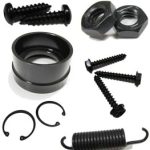
SWD Inc. is the largest Black Oxide shop in the Continental United States. We have specialized in Black Oxide for over fourty years. Other names for Black Oxide are : Black Penetrate, Black Magic, Black N, and Gun Bluing.
Click to Expand